Neighborliness is a social relationship that expresses not only the physical proximity of individuals who share the same space, but also mutual respect, solidarity, and a sense of responsibility. As one of the social bonds through which people can most easily reach one another in daily life, neighborliness creates a living environment where values such as cooperation, trust, and empathy become tangible. In this respect, neighborliness is an important social institution that reduces individuals’ sense of loneliness, strengthens social cohesion, and contributes to the transmission of cultural values from one generation to the next.
In today’s world, unfortunately, this deeply rooted social bond has gradually weakened. Even though people share the same buildings and the same streets, they have become strangers to one another. We are turning into a society where people live side by side without knowing each other, where sharing the same wall also means getting used to one another’s absence or silence. We must honestly ask ourselves the following questions:
- Do you really know Uncle Tom who lives alone next door, Aunt Carolien, or the couple Jan and Elizabeth?
- Are you aware of the neighbor whose voice has not been heard for days, whose door is rarely knocked on, and whose presence is noticed only by the envelopes piling up in the mailbox?
- Do you know your refugee-background neighbor who comes from a different nationality and culture, who does not dare to speak because of language barriers, and who even hesitates while greeting others?
- Do you notice the neighbor living on the same street, just a few steps away, trying to hold on to life alone or with a spouse, looking out onto the street every day with the hope of encountering a familiar face?
- Are we able to notice people who are waiting for someone to stop and ask how they are, who simply want their existence to be acknowledged?
- Do we know our neighbors whose grandchildren and children live far away, who long for family warmth, and who dream of setting an extra plate at the table or having a brief conversation?
- Are you afraid of Ali, Mehmet, Muhammed, or Tina, who grew up in different cultures and have a refugee background? Or is it that you do not know them well enough?
- Whose was the funeral vehicle that came to your street? How well did you know your neighbor Karin, whose life was full of experiences, who spent her final years in loneliness, and who passed away?
- When was the last time you spoke with Pieter, Mario, Wim, Miryam, Danielle, or John, who live on the same street and have no one else?
- Are you truly aware of the existence of the neighbor whose days resemble one another, who experiences moments in which loneliness slowly consumes a person from within, and who sometimes quietly lets their tears flow inward?
In modern city life, and even in small villages, people now mostly communicate not with their neighbors but with the virtual world. Without knowing who lives in the next apartment or on the next street, we can spend years sharing the same walls. Over time, neighborliness has been reduced to a brief greeting in passing, a few words about the weather, and has largely lost its depth and meaning.
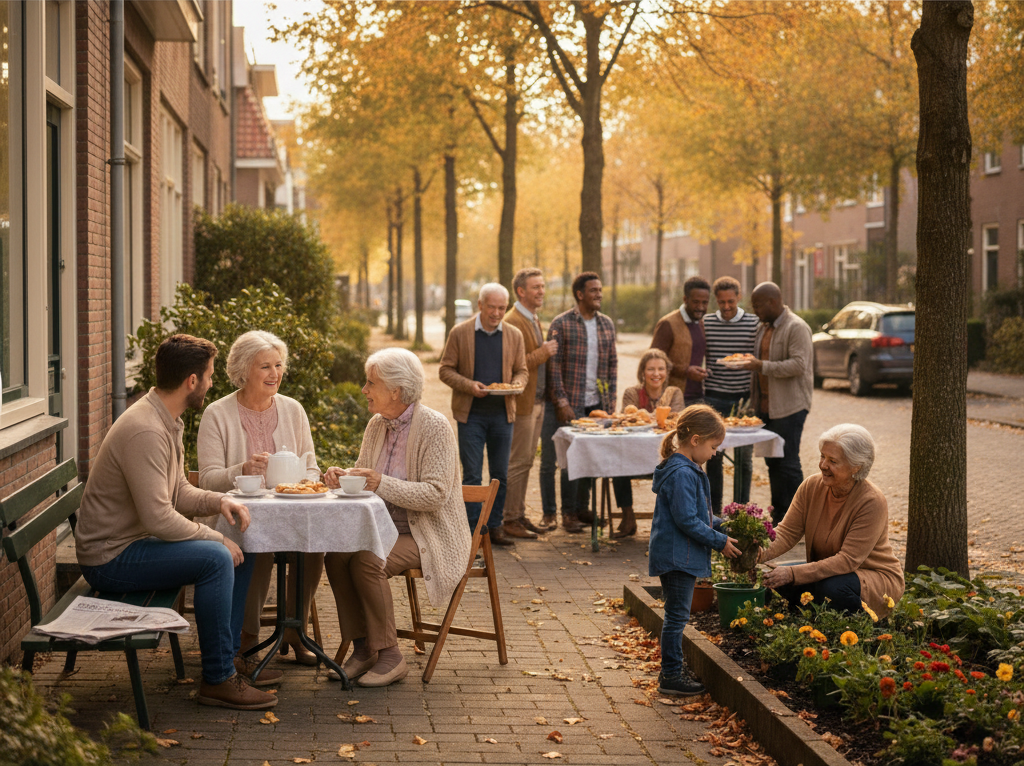
In many places, events such as “neighbourhood day” are organized with the aim of neighborliness and getting to know one another. However, these gatherings often remain symbolic days attended by only a small number of people. People do not always fear those they do not know; more often, they choose to keep their distance. As this distance grows, contact diminishes, and as contact diminishes, prejudices take root. In environments where the same table is not shared, no door is knocked on, and no one asks how the other is doing, the division between “us” and “them” quietly deepens.
Solidarity, togetherness, and empathy begin at the apartment entrance and at the corner of the street. They take root when people living on the same street first see one another as valuable neighbors. Sometimes with nothing more than a sincere “hello,” sometimes with a shared breakfast.
For social peace and solidarity, let us take the first step starting with those closest to us. Let us begin by getting to know the neighbor we do not know. Let us begin by inviting our neighbor.
Because sometimes the neighbor closest to you can be more valuable than the friend farthest away.
Solidarity Unity